You are here: Home / Shipping
ZentBuy shipping: live route board, chargeable weight and customs notes
Real ZentBuy estimator prices for twelve countries, how the warehouse turns a box into a billed weight, and what the tax-free label and route cover actually promise.
Route board for twelve countries
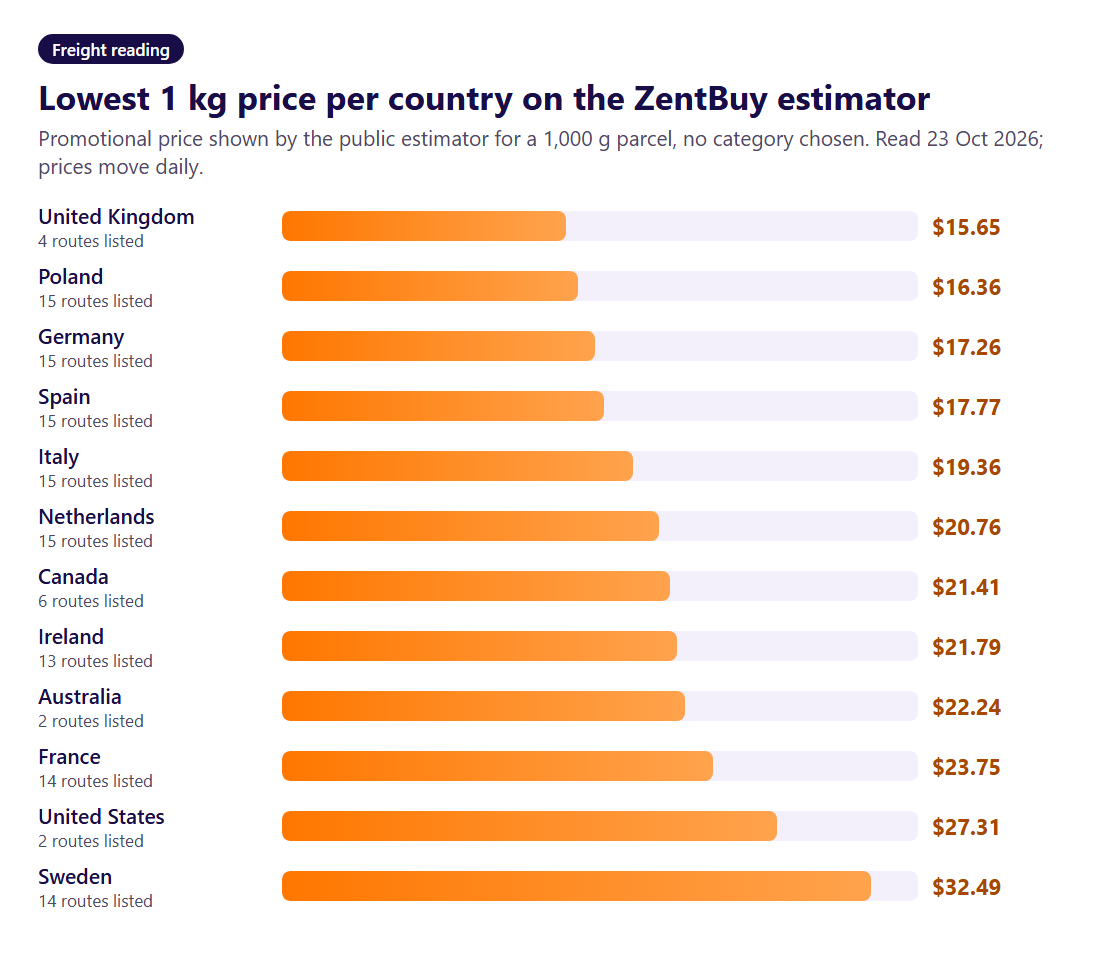
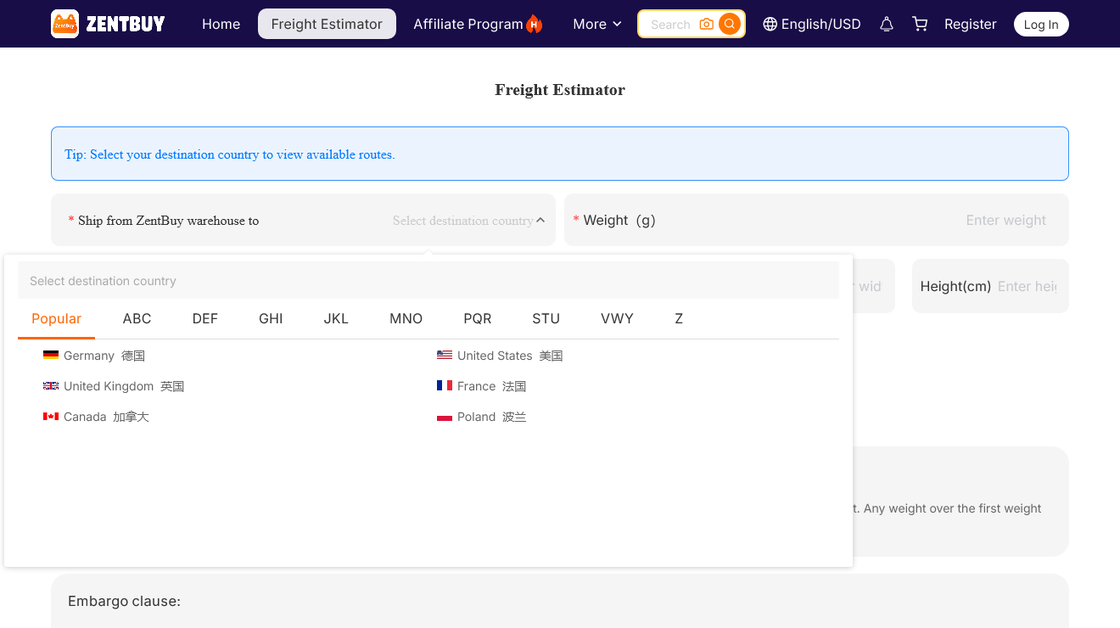
The board below is filled from ZentBuy's public freight estimator, which answers without an account. We asked it for parcels of 500 g, 1 kg, 2 kg and 3 kg to twelve countries on 23 October 2026 with no product category selected. Pick a country and weight to see every line it returned, its delivery window, its size limit and its volume divisor. Add box dimensions and the board works out the chargeable weight per line and tells you which weight step to read.
Data: ZentBuy freight estimator, 23 October 2026, 48 queries, 520 route quotes. Prices are the promotional figures the estimator displayed, with the list price beside them.
How to use the board
Start with the weight. If you know roughly what your items weigh (the warehouse records an inbound weight for each), pick the step at or above the total. Then add the box you expect. Clothing bagged tightly needs no dimensions; anything boxed does. The board compares your box with each line's size rule and marks lines it would break, and if the volume weight is larger than the step you chose it tells you which step to read instead.
Three limits apply. The board holds four weight steps, not a continuous price curve. It uses no product category, so lines that refuse batteries or liquids still appear. And promotional prices change; on 23 October every quote showed a 40% reduction. For your actual parcel, the ZentBuy parcel screen is the only place with a binding number. The ZentBuy estimator itself is open to anyone.
Chargeable weight in practice
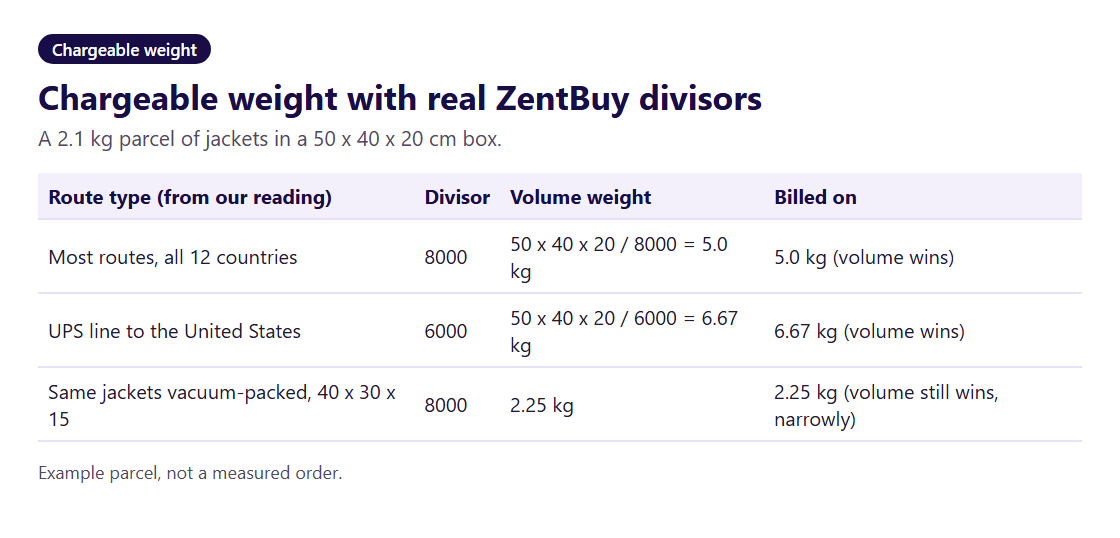
ZentBuy bills each parcel on its chargeable weight, which is the scale reading or the volume figure, whichever is higher. The volume figure is the carton's cubic centimetres over the route's divisor. In our reading, 516 of 520 quotes used 8000 and the remaining four (the UPS line to the United States, at each weight) used 6000. A smaller divisor makes the same box heavier on paper.
For clothing this rarely matters, because soft items compress. For shoes, coats and bags it often decides the bill. The example below uses a 50 by 40 by 20 cm carton of jackets that weighs 2.1 kg: on an 8000 line it bills as 5 kg, on the 6000 line as about 6.7 kg, and vacuum-packed into 40 by 30 by 15 cm it bills as 2.25 kg.
Delay, loss and seizure cover
Without extra cover, ZentBuy's compensation article is plain: delays are not compensated, because most carriers do not compensate them either. Loss and damage are handled under ZentBuy's own standards after verification, paid as account credit, provided you raise the claim within 7 days of delivery or 45 days of shipping and have the evidence.
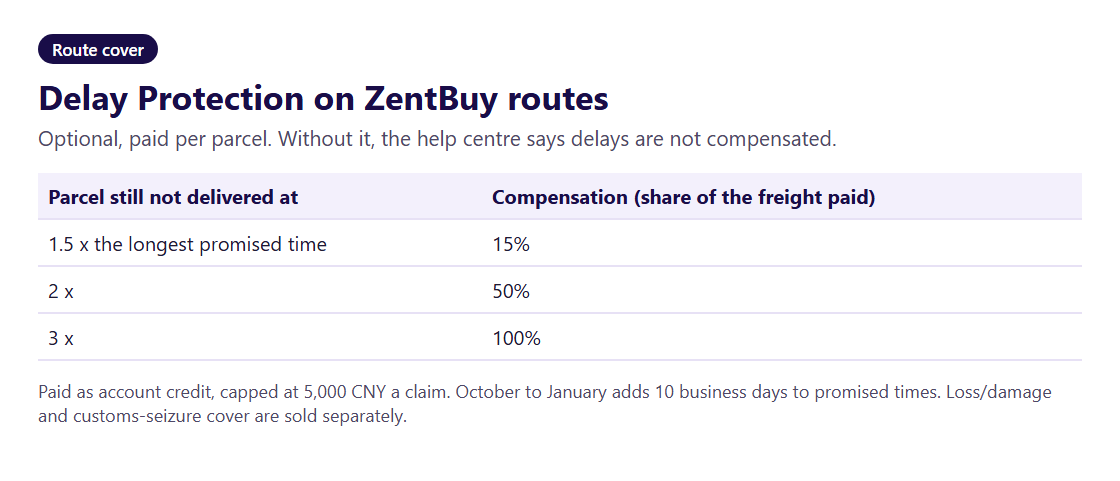
Every line in our reading also sold optional cover. Delay Protection refunds part of what you paid for freight if the parcel has not arrived by 1.5 times (15%), 2 times (50%) or 3 times (100%) the longest promised time, with ten business days added to promised times from October to January. Loss/Damage Protection and Customs Seizure Protection are separate. Claims are paid as account credit and capped at 5,000 CNY each.
ZentBuy also splits its lines into self-operated routes, where it applies its own after-sales standard, and partner routes, where it claims from the carrier on your behalf and the carrier's rules decide the outcome. The estimator quotes we read did not say which kind each line is, so ask support before you rely on it.
Tax-free lines, declared values and customs
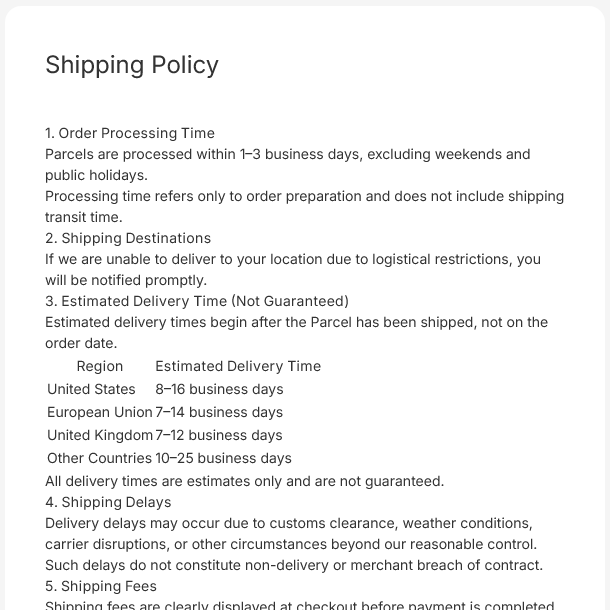
Every one of the 520 quotes we read carried the label "Tax free". ZentBuy's shipping policy notice explains what that means on its side: on lines carrying the label, ZentBuy itself pays the duty and VAT and deals with clearance, and on any other line those costs land on you. That is the company's statement about its own lines; it does not change the law in your country.
The customs article adds that weight, value, bulk and repeats of one item all raise the odds of an inspection, and that any costs from a returned or destroyed parcel fall on the recipient. ZentBuy publishes a table of tariff thresholds by country but labels it as collected from online sources and not official guidance; check your own customs authority for current figures.
Silent tracking and how to read it
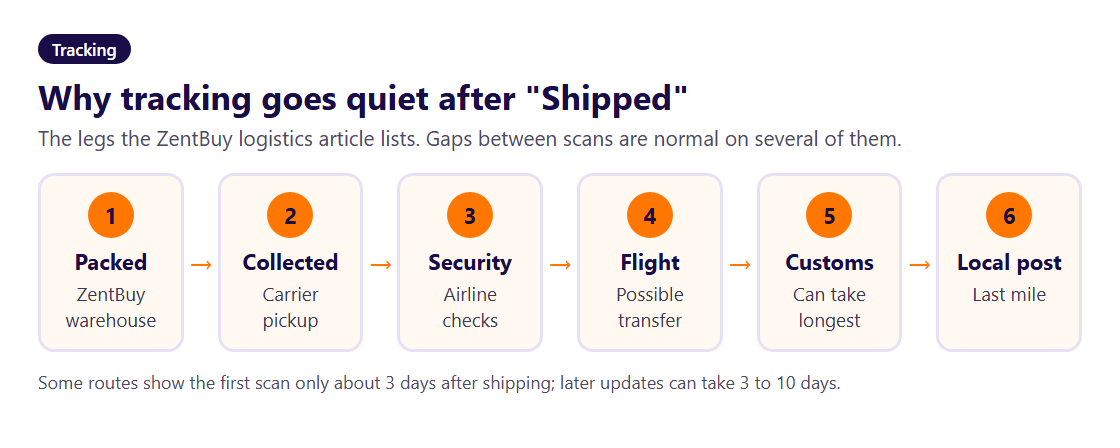
After the Shipped (International) status, a parcel passes through packing at the warehouse, carrier collection, airport security, a wait for a flight (sometimes with a transfer), arrival processing, customs and finally a local delivery company. Several of those hand-overs produce no scan. ZentBuy warns that on certain lines the first scan appears only around three days after dispatch, that later scans may come three to ten days apart, and that slow lines get a note under the parcel.
"Out for delivery" that never turns into "Delivered" usually means the local courier tried and failed; the help centre's advice is to call the local post office or courier yourself. If nothing moves for much longer than the stated windows, open a ticket with the parcel number.
The EU change from November
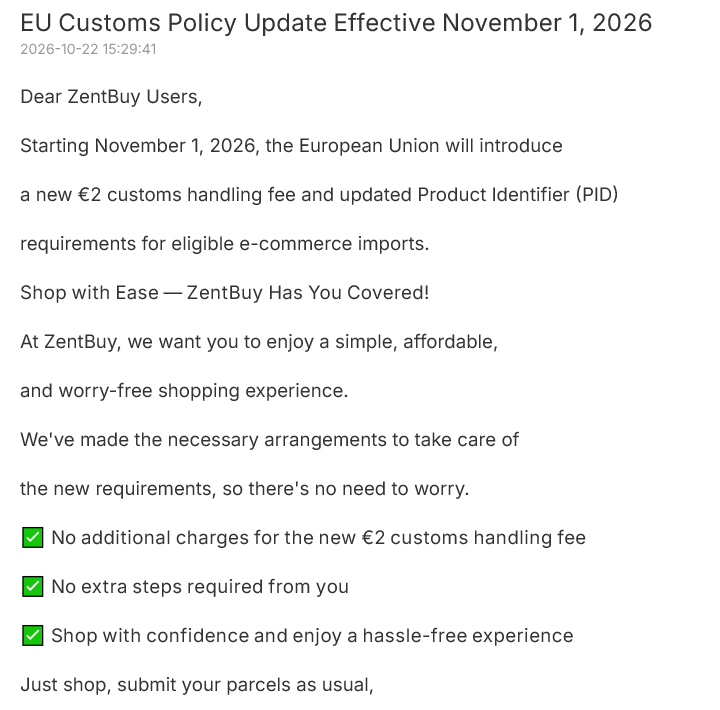
On 22 October 2026 ZentBuy announced that from November 1 the European Union introduces a €2 customs handling fee and updated product identifier requirements for eligible e-commerce imports. ZentBuy says it has made arrangements so that buyers pay no extra charge for the €2 fee and need to take no extra steps, and that it will announce any change to that arrangement in advance.
For EU buyers this is good news for small parcels, but it is a company commitment rather than a rule, so it is worth re-reading the notice if you place a large order later in the winter. We log any update on the updates page.